
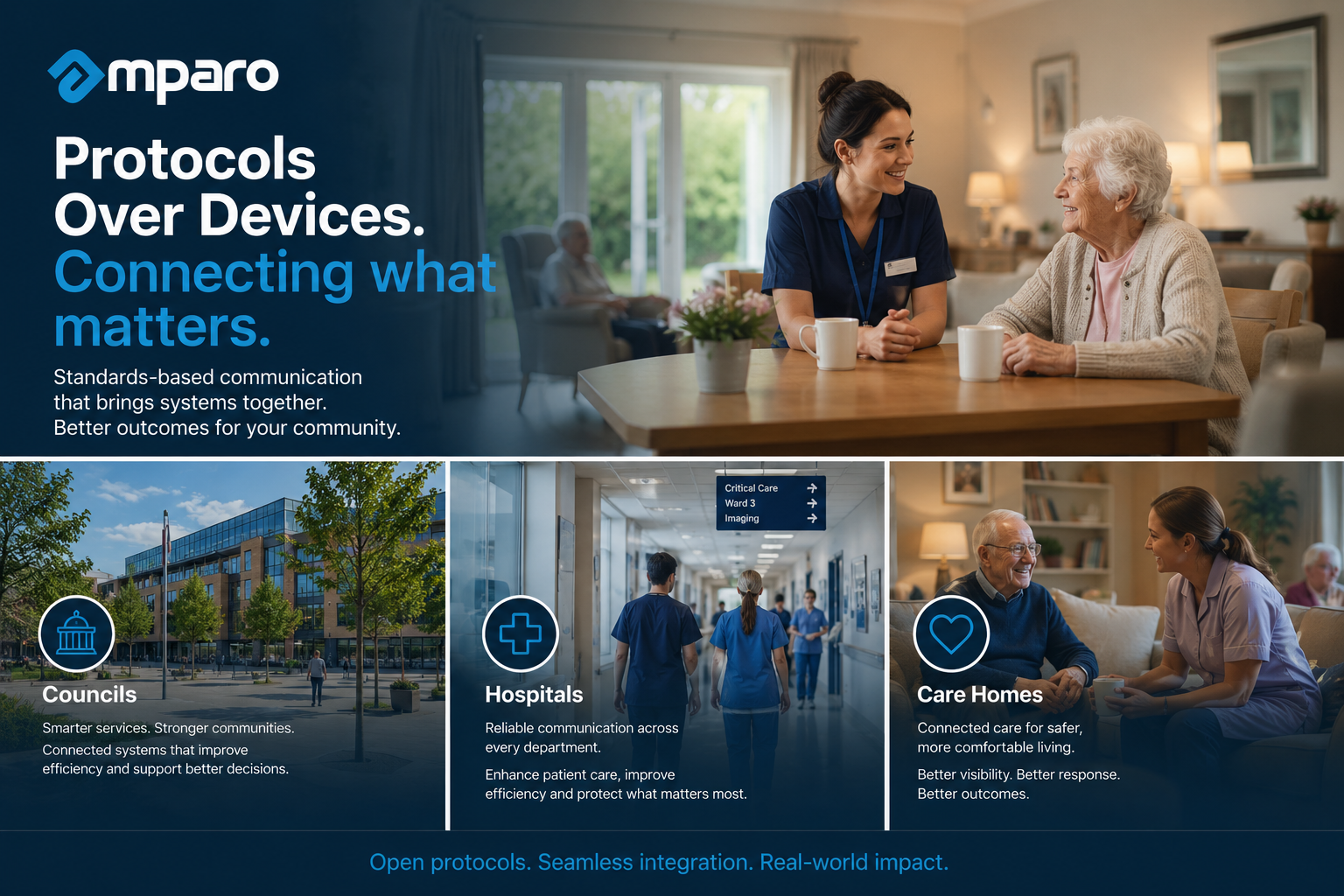
If you’re evaluating digital telecare or connected-care technology right now, you’ve probably heard a lot of vendors talk about their devices — pendants, sensors, hubs, alarms. What you’ve probably heard less about is the thing that actually determines whether your technology investment still works in five years: the protocol underneath it.
At Amparo, we describe our approach as “protocols over devices.” Here’s what that means in plain English, and why it should matter to anyone re-procuring telecare or connected-living technology in the run-up to the UK’s analogue switch-off.

The problem with buying devices first
Most telecare systems on the market today are built around a specific manufacturer’s hardware. You buy their pendants, their sensors, their base units — and, crucially, their software to manage it all. It works fine, until you need to add a device that manufacturer doesn’t make, switch to a cheaper supplier, or connect your telecare system to something else entirely, like a housing management platform or a hospital’s remote monitoring tools.
That’s when the lock-in becomes obvious. Because the whole system was built device-first, swapping any part of it means ripping out and replacing the lot. You’re not just buying hardware — you’re committing to one company’s roadmap, one company’s pricing, and one company’s pace of innovation, indefinitely.
"Protocols over devices" — what it means instead
A protocol is simply the shared language that lets different pieces of technology talk to each other — think of it like a common alphabet rather than a proprietary code only one manufacturer understands. When a platform is built around open, standards-based protocols rather than a specific set of devices, it doesn’t care whose hardware is plugged into it. A sensor from one manufacturer, an alarm from another, and a monitoring device from a third can all sit on the same platform and be managed the same way.
This is the model Amparo’s solutions are built on. Rather than manufacturing our own proprietary hardware and locking customers into it, our platform is designed to work with devices from any manufacturer, connected through open, standards-based protocols — including BS 8684, the UK’s new Technology Enabled Care (TEC) standard introduced in January 2025. If a device speaks a recognised protocol, it can join the platform.
Why this matters for buyers right now

For local authorities, alarm receiving centres, and care providers facing the UK’s analogue switch-off — which completes in January 2027 — this distinction isn’t academic. It’s the difference between a genuine long-term upgrade and a short-term fix that locks you into the same problem a few years from now.
Three things are worth thinking through as you evaluate options:
- You keep control of your own roadmap. With a protocol-based platform, you’re never stuck waiting for one manufacturer to release a device you need, or paying whatever they decide to charge because you have no alternative. You can add, swap, or mix devices as your needs change or as better technology comes to market.
- Interoperability stops being a project. Care technology increasingly needs to connect across services — telecare, housing, healthcare, building management. A platform built on open protocols is designed for this from the outset, rather than requiring costly integration work every time you want two systems to talk to each other.
- Standards compliance is built in, not bolted on. Following an open standard like BS 8684 isn’t just good practice; it’s increasingly what commissioners and regulators expect. A platform that’s aligned with the standard from the ground up gives you a stronger footing for procurement and audit than one that’s been retrofitted to comply.
The bottom line
When you’re choosing telecare or connected-care technology, it’s tempting to focus on the devices in front of you — how they look, what they cost, what features they have. But the more important question is what’s underneath them: is this system built around one manufacturer’s hardware, or around an open standard that any hardware can join?
Protocols over devices means you’re buying flexibility, not dependency. As the switch-off deadline approaches and care technology needs to do more — connecting telecare, housing, healthcare, and buildings — that flexibility isn’t a nice-to-have. It’s what determines whether the platform you choose today still serves you well in ten years’ time.
Want to understand what the analogue switch-off means for your organisation? Download our free Switch-Off Guide, or get in touch to arrange a conversation.

Smart, Secure, and Future-Ready: How Amparo Technologies Protects Your Home or Organisation
Explore the ground-breaking impact of smart building, home and security solutions, enhancing both accessibility and quality.In today’s world, security is no longer just about locks and alarms—it's about intelligence, integration, and prevention. Whether you're...

The Rise of Digital Telecare in Portugal: A New Era of Connected Support
Explore the groundbreaking impact of digital health solutions on patient care across Portugal, enhancing both accessibility and quality.Portugal is entering a new chapter in health and social care with the rapid expansion of digital telecare services. Driven by an...

Healthcare Interoperability: The Missing Link in Digital Transformation
Explore the groundbreaking impact of digital health solutions on patient care across Portugal, enhancing both accessibility and quality.Despite a surge in digital health innovation, many healthcare organisations still struggle with one fundamental issue:...